
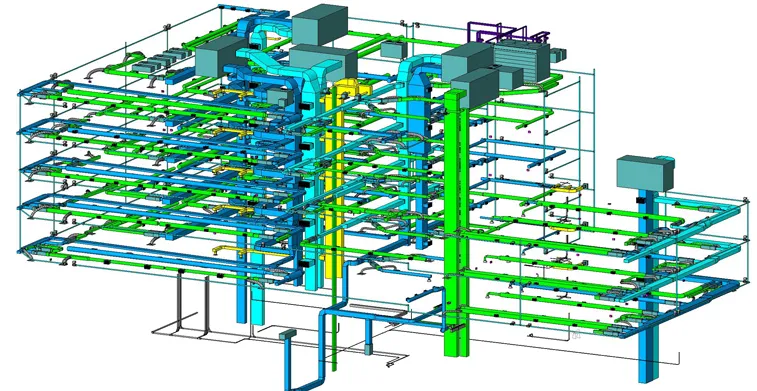
Construction projects usually do not go off track because of one huge mistake. They drift because of a lot of small ones. A missed opening. A late design change. A clash nobody caught in time. A quantity that looked close enough on paper but was not close enough once the job started. Research keeps showing the same pattern: BIM can reduce design errors by 50–60%, clashes by 40%, rework costs by 40–50%, construction waste by 4.3–15.2%, and unbudgeted changes by 37–62% in the projects studied. Those are not abstract wins. They are the difference between a budget that behaves and a budget that keeps bleeding.
The model should be the cost map, not just the visual record
BIM Modeling Services are useful because they turn the building into something measurable. Autodesk describes BIM as a holistic process for creating and managing information for a built asset, with structured multidisciplinary data that follows the project from planning and design through construction and operations. That matters because a model that is only decorative does not help much with cost control. A model that carries usable information does. It gives the team a way to measure scope, compare options, and catch problems before they turn into expensive field work.
A model that can actually support cost control usually has a few basics in place:
- consistent naming for families and assemblies
- useful attributes for material, finish, and unit
- geometry that reflects the real buildable scope
- clean exports in a shared format
- trade separation so different systems do not blur together
That kind of discipline sounds simple, but it is where good estimating starts. If the model is not clean, the estimate will not be clean either.
What recent BIM studies report
| Reported BIM effect | Result from recent studies | What it means for project control |
| Design errors reduced | 50–60% | Fewer corrections and fewer design misses |
| Construction waste reduced | 4.3–15.2% | Less over-ordering and less disposal loss |
| Rework costs reduced | 40–50% | Lower labor waste |
| Coordination of RFIs reduced | 80% | Faster decisions |
| Change orders reduced | 32% | Better budget stability |
| Unbudgeted changes reduced | 37–62% | Less surprise cost movement |
These figures are reported study results, not universal averages. They show the scale of improvement possible when BIM is used well.
The practical point is clear. When the model is structured properly, the team spends less time fixing bad counts and more time making decisions. That is what makes BIM useful before the first order is placed.
Why rework usually starts as a coordination problem
Rework rarely announces itself. It creeps in. A duct clashes with a beam. A finish changes after the room layouts are already priced. A route that looked fine in 2D turns out to be impossible once the ceiling space is real. BIM is valuable because it lets those problems show up in the office, where change is cheap. A 2025 case study on BIM and project performance reported that BIM reduced design errors, clashes, and rework while also improving labor scheduling and cost estimation time. Another 2025 bridge study linked BIM adoption with 70–85% less time wastage and 65–75% cost savings in the modeled scenarios. Those are case-specific, but they show the direction clearly: earlier coordination means fewer expensive surprises later.
BIM also helps with sustainability, and that is not a side benefit. A 2025 Indonesian case study showed BIM being used from 3D through 6D dimensions to optimize productivity, identify clashes, and evaluate embodied carbon. That matters because rework is waste, and waste is money. If a team can reduce it early, the budget and the carbon footprint both improve.
How rework becomes cost
| Problem found late | What happens on site | Cost effect |
| Clash between systems | Rerouting, removal, restart | Labor loss + schedule delay |
| Missing scope item | Emergency ordering | Rush fees + higher risk of error |
| Wrong quantity | Over-ordering or under-ordering | Waste or downtime |
| Design change after buyout | Repricing and resubmittals | Change order risk |
This is why rework is not just a technical issue. It is a budget issue from the moment the first clash is missed.
Turning quantities into budgets that hold up
A model gives quantities. It does not yet give a budget. That is where Construction Estimating Companies matter. Estimating is the step where direct costs, indirect costs, labor, equipment, overhead, and contingency are turned into a usable financial plan. Procore’s estimating guidance describes this clearly: estimators must account for direct project costs and also indirect field and overhead costs, such as permits, temporary offices, site cleaning, equipment, software, and business overhead. SMACNA says the same thing more bluntly: estimating is the process of calculating all required project costs, including direct and indirect costs, so contractors can stay profitable.
That is where the estimator’s judgment becomes essential. A quantity for drywall may be exact, but the install cost will still change depending on access, staging, weather, and how congested the space is. The same is true for mechanical, electrical, and finish packages. The estimator turns clean quantities into a budget that reflects how the work will actually happen.
A good estimating workflow usually asks these questions:
- What is the direct cost of each package?
- What indirect costs sit behind the work?
- What labor productivity is realistic for this site?
- What items are long-lead and need early buyout?
- What scope items could shift if the design changes?
When these questions are answered early, procurement gets easier, cash flow gets steadier, and the owner sees a number that can be defended.
Sample savings from tighter model-led control
Illustrative example only.
| Budget item | Traditional approach | BIM-led approach | Difference |
| Rework reserve | $120,000 | $60,000 | $60,000 saved |
| Materials waste | $180,000 | $125,000 | $55,000 saved |
| Rush delivery fees | $25,000 | $10,000 | $15,000 saved |
| Total impact | $130,000 saved |
This calculation is simple on purpose. If the model and the estimate are tighter, small percentage gains become real money very quickly.
Procurement gets smarter when the model drives the buying plan
Procurement is where a lot of budgets quietly leak. Buy too early, and money sits in inventory. Buy too late, and the crew waits. Buy from the wrong revision, and the project pays twice. A 2024 ScienceDirect review on BIM and sustainable construction notes that BIM supports supply-chain optimization through accurate forecasting and just-in-time delivery. Another paper on BIM-based procurement planning describes a framework for generating project schedules and ordering plans so material flows can match the job instead of fighting it.
That is the practical advantage: the model becomes the basis for purchase timing, not just for design review. It helps teams reduce storage, handling, and waste.
What smarter procurement looks like
- Quantities are extracted from the current model revision
- Materials are grouped into purchase packages
- Long-lead items are flagged early
- Delivery windows are tied to the schedule
- Revisions trigger a fresh check before orders go out
That is a much better process than buying off assumptions and hoping the drawings do not change.
Why repair and claims work needs a different language
Some jobs are not straight new-build work. Restoration, damage repair, and insurance-driven projects need an estimate that can be reviewed line by line. That is where Xactimate Estimating Service fits naturally. Verisk describes Xactimate as property claims estimating software that is precise, fast, and flexible, and its pricing services are backed by independently researched reconstruction pricing data. Verisk also says those data services support transparent, market-based pricing and help users understand how estimates are built. In the pricing-data PDF, Verisk states that its system draws on 400,000+ daily estimate submissions and monthly updates, which gives the platform a strong claims-and-restoration use case.
In plain terms, Xactimate is useful when the scope must be explained to an adjuster, owner, or other reviewer in a standardized format. The model gives the scope. The estimate gives the price. Xactimate gives the report a structure that people on the claims side already understand. That reduces friction when the work is changing fast, which is usually the case in damage and restoration jobs.
The adoption pattern that works in real projects
A lot of teams try to adopt BIM and estimating all at once, and then get frustrated. The better path is smaller and more disciplined.
- Set naming and measurement rules at kickoff.
- Build the model with estimation in mind, not just presentation in mind.
- Run a sample takeoff early and compare it against field reality.
- Update quantities at each major milestone.
- Reprice the affected scopes before decisions are locked.
- Keep one mapping file between model families and cost codes.
- Use a structured claims format only when the audience needs it.
That process looks basic because it is. But basic process discipline is what keeps budgets from drifting and keeps procurement from becoming guesswork.
Final thought
BIM is not a magic wand. It is a better way to see the project before it becomes expensive to change. When BIM Modeling Services create a trustworthy model, when Construction Estimating Services turn that model into a real budget, and when Xactimate Estimating Services are used for claims or repair work that needs a structured format, the project gains control in the places that matter most: scope, cost, and timing. That is how rework is reduced. That is how surprises stay small. And that is how a project becomes more predictable from the first estimate to the last invoice.
FAQs
1. How does BIM help reduce rework?
BIM helps by exposing clashes, missing scope, and quantity issues before construction starts. Recent case studies report reductions in design errors, rework costs, and change orders when BIM is used properly.
2. Why do estimators still matter if the model gives quantities?
Because quantities are not budgets by themselves. Construction Estimating Services add labor, indirect costs, overhead, and productivity assumptions so the numbers reflect real site conditions.
3. When should Xactimate be used?
It is most useful in restoration, claims, and damage repair work where the estimate needs to be presented in a standardized, auditable format with regional pricing.
